
You’ve probably seen this happen before: An adult child or a potential resident searches for a community on Google, clicks the top result and ends up on an aggregator or third-party referral site like A Place for Mom, Caring.com or SeniorAdvisor.com instead of your website.
These sites show up first in search results because they have strong authority, lots of content and deep pockets for paid advertising. There may be some elements of their strategy your community can’t compete with, but you can still get noticed and beat them out if you play the SEO game right.
This guide shares practical SEO tips to help your community’s online visibility and attract more visitors to your website. It’s time to get ahead of referral sites and reach more potential residents directly—saving you time and money.
Know Your Enemy: Why Aggregators Win at SEO
Aggregators have built their dominance in search over time using domain authority, backlinks and content volume.
They also use paid search to target your community name in ads served to your audience, using your own pricing as the bait. In practice, a family member or senior searching specifically for your community may see a paid ad at the top of Google that reads something like:
“[Your Community Name], Starting at $3,000/mo—A Place For Mom.”
If they click, the first interaction happens on the aggregator’s platform—not yours. When that happens:
- You lose control of the first impression.
- They may show prospects competing communities.
- Your team gets less insight into what the searcher was actually looking for.
- You give up a lead that was actually looking for your community.
From there, your prospect becomes a paid referral lead that the aggregator site sells back to you. Meaning you end up paying to re-acquire a prospect who was already looking for you!
While it may seem like the answer is to spend more, trying to outspend large aggregators isn’t a winning strategy. The smarter approach is defensive. Optimizing your SEO is what will help you compete with the big aggregator sites. Here are six key tips on how to do it.
1. Non-Negotiable: Own Your Brand Terms
According to WebFX, 44% of all Google searches are for branded terms, with people looking for something they already recognize.
These branded searches represent your highest-intent prospects. They’ve likely heard about your community through a referral, an ad or word of mouth, and they’re just a step away from reaching out.
Start with Your Title Tags
Title tags are among the most important (and often overlooked) elements on your site. Use a format that clearly communicates both your brand and your location. For instance:
“Compassionate Assisted Living in Portland, ME | Sunny Acres Senior Community.”
Also, make sure your full community name appears in your homepage meta description, use clear, descriptive URLs on all pages and keep your XML sitemap up to date. The sitemap guides search engines to your most important pages.
These small steps help search engines connect your community to relevant local searches, while also making your listing more compelling for families scanning results.
Keep Your Information Consistent
It may seem like a no-brainer, but making sure your name, address and phone number (NAP) are consistent across the web is one of the most important steps you can take to strengthen local SEO signals, yet many organizations overlook this simple task.
Consistency on your site is one of the factors search engines use to determine whether your business is legitimate and accurately represented. Even small differences (like “Street” vs. “St.” or a missing suite number) can create confusion for search engines and weaken your rankings.
What to do:
- Audit your listings using tools like BrightLocal, Moz Local or Whitespark to identify any discrepancies on your site so that you can fix them.
- Standardize your name, address, phone number, hours and service descriptions everywhere they appear.
- Place your NAP in the footer of every page on your website so it’s easy to find and consistently indexed.
Use Schema Markup
Schema markup gives search engines a clearer context about your website, improving how your community appears in search results. It can make your site eligible for enhanced listings, such as featured snippets, which often attract more clicks.
Schema tells search engines, “This is a senior living community. Here’s the name. Here’s the address. Here are the services provided.”
For senior living communities, LocalBusiness and HealthCareFacility schema types are especially useful.
Best practices:
- Use JSON-LD format (Google’s preferred method).
- Test your setup using Google’s Rich Results Test tool to ensure everything is working correctly.
2. Reviews: An SEO Advantage
Don’t overlook the importance of reviews: they play a direct role in how your community shows up in search.
Google looks at both the quantity and quality of reviews, as well as how actively you engage with them, when determining local rankings. Your review strategy can directly influence whether your community is seen or overlooked.
Be sure to respond to every review, positive and negative. Google’s algorithm rewards engagement and families read your responses as a proxy for how you treat residents. The goal is steady, authentic feedback over time, not a one-time push.
Start with a simple, repeatable process:
- Ask for reviews at the right moment, for instance, after a positive tour, move-in milestone or family interaction.
- Use direct links or QR codes to reduce friction and make it easier for people to leave reviews.
- Train your team to incorporate review requests naturally into conversations.
It’s a relatively simple area to improve, but when done well, it can have an outsized impact on your visibility, credibility and first impressions.
Don’t rely on just one platform
While reviews on your Google Business Profile are the most influential, that shouldn’t be your only focus. Some other place to focus when it comes to reviews:
- U.S. News & World Report
- Senior living-specific directories like the ones mentioned earlier that steal your traffic
Each platform reaches a slightly different audience, and together, they create a more complete and trustworthy online presence.
3. Google Business Profile: The Low-hanging Fruit Most Communities Overlook
Your Google Business Profile (GBP) is often the first place families interact with your community and in many cases, it shapes whether they call, click or keep searching.
For searches like “memory care near me” or “assisted living in [city],” your Google Business Profile may be one of the primary sources Google uses to generate AI-driven and local results.
Communities that actively optimize their GBP profiles have 5x higher engagement rates and 23% more phone calls, yet many organizations don’t complete their profiles and rarely update them.
An Optimized Profile checklist:
- Accurate name, address and phone number (NAP).
- Updated business hours.
- 10 high-quality photos, including the interior, exterior, team and amenities.
- The correct care level categories.
- A FAQs section to address common questions.
- Publish “updates” (at least twice per month).
There are also newer features, like video testimonials, live chat and AI-driven suggestions that many communities haven’t fully explored yet, creating an easy opportunity to stand out.
4. Hyper-local SEO: Your Biggest Advantage
Local search is where your community can really shine.
Searches like “senior living in [your city]” or “memory care near me” are highly actionable—and unlike the aggregators, you actually live and operate in that community, which gives you more authority and authenticity.
Where to focus:
- Create dedicated pages for your city or service areas, but avoid thin, copy-and-paste content.
- Mention nearby landmarks, neighborhoods and even zip codes to capture highly specific searches and reinforce your local relevance.
- Build relationships with hospitals, churches, senior centers and local media in your area. When they link to your website, those backlinks act as trust signals for both traditional search engines and AI-driven search. High-quality backlinks strengthen your authority and geographic relevance and increase your visibility.
Build Content Aggregators Can’t Replicate
Only you can tell your community’s story; you live it and your residents do too. Staff spotlights, resident stories and event recaps can give families a real sense of your culture.
That kind of content is authentic and engaging and it helps you stand out in ways aggregators simply can’t.
What works best:
- Content with keywords such as “what’s included in assisted living costs in [state]” aligns with what families are actively researching.
- Content that has a long shelf life, such as guides, checklists and FAQs, builds trust over time and often earns backlinks, which support your overall SEO.
- Video is increasingly visible in search results and can showcase your community in a more appealing and engaging way.
Structure Your Website So Google Understands Who and Where You Are
Search engines rely on clear, consistent signals to understand your community’s name, location and services. The more precise you are, the easier it is for Google to rank you correctly.
One of the simplest (and most important) checks you can make is to review your branded search performance in Google Search Console.
If your homepage isn’t appearing in the top one or two positions, it’s a sign that something isn’t working as it should. That’s worth addressing right away.
Don’t Ignore Technical SEO Fundamentals
The best content won’t help solve your problems unless your website is technically sound in areas such as site speed and user experience. Adult children, for instance, often use their mobile devices to research. A slow-loading or hard-to-navigate site that is not optimized for mobile can quickly lose that visitor.
When local relevance, authentic content and strong technical performance come together, you create something aggregators can’t easily compete with: a clear, credible and compelling digital presence rooted in your community.
5. The Emerging Frontier: AI Ads
OpenAI now has ads in ChatGPT. As AI platforms are becoming more popular when it comes to search, they are playing a significant role in how families research senior living options.
According to eMarketer, the U.S. market for AI search advertising will grow from $1 billion in 2025 to $25.9 billion by 2029, and account for 13.6% of all search ad spending.
Because ads contextually match what a user is asking, a family searching for your exact community may now see a sponsored placement from a referral site, such as A Place For Mom, directly within their conversation and continue their journey on the referral site instead of yours.
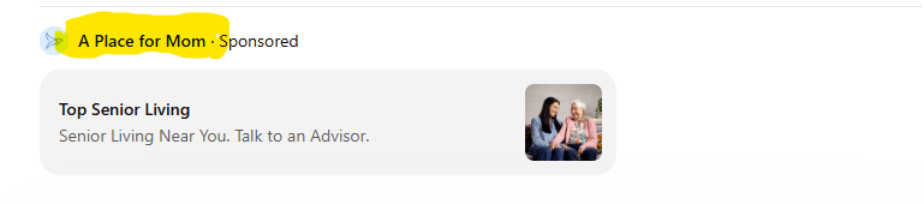
That makes your organic optimization work even more important. Start monitoring whether aggregators begin appearing in AI-generated responses for your community name. It’s your best defense against aggregators and key to maintaining visibility as search continues to evolve.
To compete, strengthen your SEO. One important, yet underutilized technique, is developing an LLMS.txt file.
An LLMS.txt file is similar in concept to a robots.txt or sitemap.xlm file, but it is designed specifically for large language models, like ChatGPT. It gives AI crawlers and assistants a structured guide to the key information on your website, helping them better understand things like your services, location and expertise.
Results: Track, measure and adjust
A strong strategy is only as good as what you learn from it. So, it’s essential to measure results to understand what’s working, what isn’t and where to focus next.
Things to consider:
- Are more people finding you through organic search?
- Are you appearing in the local pack, map-based results for key searches?
- Are you capturing people already looking for you and reaching those who aren’t yet familiar with your community?
Tools such as Google Search Console, Google Analytics 4, BrightLocal and Semrush can not only help you capture your metrics but also benchmark your results against competitors.
Wrapping it all up
You need to own your brand and your local market, not outspend and outrank all the aggregator and referral sites. When someone searches for your senior living community by name or for senior care in your area, your community should be easy to find and contact.
Valuable content, strong local signals and a technically sound website work together to build traffic you control, relationships you own and leads that come directly to you.

Too busy to do the work yourself? Call EVR to schedule a free audit to see where you stand—and where you can grow.
Mackenzie Fraser | Senior Vice President
(603) 647-8606 x209
MackenzieF@evradvertising.com